
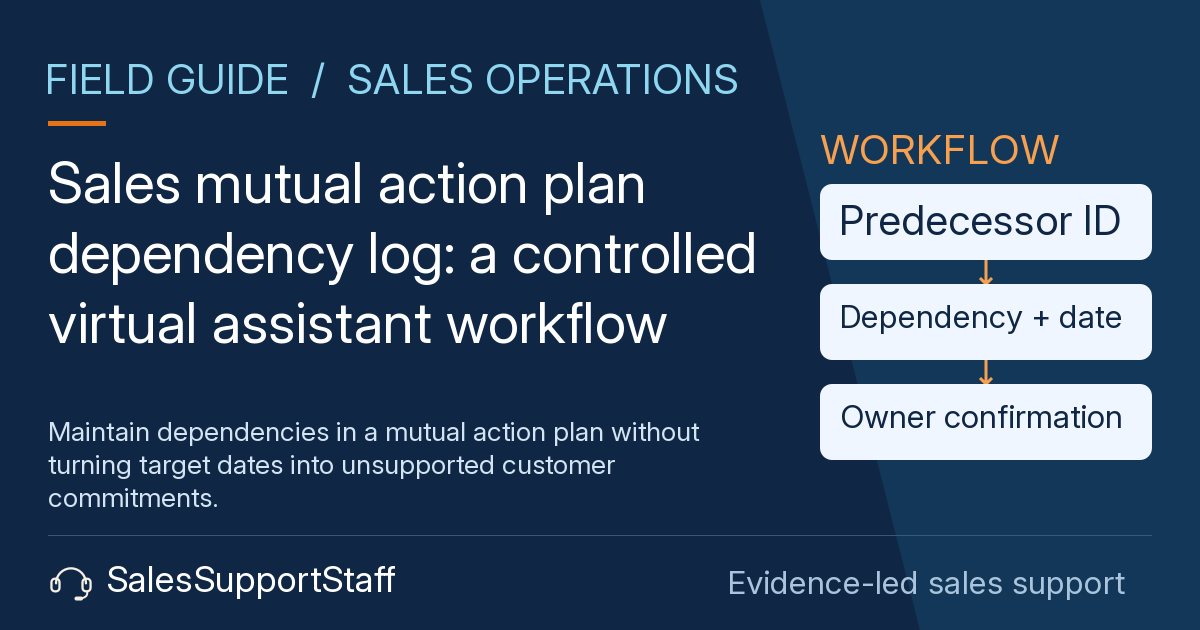
A mutual action plan becomes misleading when tasks look independent even though one cannot start until another finishes. The dependency log should expose those relationships, identify whose confirmation is missing, and preserve the difference between a proposed date and a committed date.
Model every mutual action plan dependency log entry explicitly
Give every milestone a stable ID and record predecessor IDs, dependency type, owner, evidence link, target date, and date status. Use finish-to-start only when completion is genuinely required; label advisory sequencing separately. A note that says “legal before signature” is too vague to calculate or audit.
Check for circular paths and milestones whose predecessor does not exist. When two plans use different names for the same deliverable, link them through an alias field rather than merging records without owner review.
Calculate impact without pretending to forecast
When a predecessor date moves, identify downstream milestones whose earliest possible start changes. Show the original date, proposed date, and arithmetic used; do not overwrite a customer-approved target. Calendar-day and business-day calculations must name the calendar and time zone.
A missing duration is an exception, not zero days. Surface it to the milestone owner and leave downstream dates uncalculated until an approved assumption exists. This prevents a clean-looking plan from concealing an unknown critical path.
Run a focused change review
Review newly added dependencies, date changes, owner changes, and items with no recent evidence. Ask each named owner to confirm only their affected rows. Preserve rejection reasons and superseded versions so later readers can reconstruct why the plan changed.
The handoff should identify the blocked milestone, predecessor, last confirmed evidence, date effect, required decision, and accountable owner. The assistant maintains the graph; customer commitments and commercial escalation remain with the deal team.
Model dependencies, not just dates
For every milestone, name the deliverable, responsible party, prerequisite, acceptance evidence, target date, and source of commitment. Connect dependencies explicitly so a delayed security response can be traced to the legal review or technical validation it blocks. A date with no owner or predecessor is a calendar note, not an actionable plan item.
NIST's Baldrige Excellence Framework offers general background for assessing organizational processes and results. It does not certify a sales plan or prove a customer commitment. Commitments must come from authorized communications, and internal estimates must remain labeled as estimates.
Age blocked work honestly
Start dependency age when the required predecessor becomes due or when the team first records that it is blocking progress, according to the approved rule. Pause only for defined states such as an agreed customer hold. Keep original target dates visible when forecasts move so schedule churn does not erase lateness.
Classify blockers as missing input, owner unavailable, evidence rejected, scope decision, technical issue, or external dependency. Escalate by impact and next milestone rather than sending generic overdue reminders. A useful escalation shows the blocking item, affected commitments, elapsed time, evidence requested, and decision owner.
Review the network each week
Test a simple sequence, two parallel prerequisites, a circular dependency, and a milestone whose owner changes. The system should reject cycles, retain ownership history, and recalculate affected dates without overwriting the baseline. Close a dependency only when its acceptance evidence is attached.
Report open blockers, median and oldest age, milestones with no valid owner, reopened dependencies, and forecast changes by cause. Keep customer-visible communication under the account owner's control. See the sales operations virtual assistant guide for recurring queue governance.
Commission the queue deliberately
Create a pilot sheet with milestone, predecessor, deliverable, internal owner, customer owner, baseline date, forecast date, and acceptance evidence. Require the deal owner to approve field definitions, acceptable sources, and stop conditions before access is granted. Include one ordinary record, one incomplete record, one conflict, and one edge case where a missed prerequisite moves downstream milestones.
For Sales mutual action plan dependency log, ask the candidate to process milestone, predecessor, deliverable, internal owner, customer owner, baseline date, forecast date, and acceptance evidence without customer contact or production edits. Review whether the output preserves received values, identifies controlling evidence, explains each stop, and routes decisions to the named owner. Reject work that looks tidy but cannot be rebuilt from attached sources.
Document role access for milestone, predecessor, deliverable, internal owner, customer owner, baseline date, forecast date, and acceptance evidence; remove export privileges unless Sales mutual action plan dependency log requires them, and test revocation before the pilot ends. Keep sample data synthetic or appropriately minimized. Record retention and deletion responsibilities beside the queue owner so cleanup becomes an operating step.
After launching Sales mutual action plan dependency log, inspect risk-based and random samples across milestone, predecessor, deliverable, internal owner, customer owner, baseline date, forecast date, and acceptance evidence. Compare false acceptance, false return, unresolved cases, reopened records, and correction time, with denominators and exclusions visible. When a governing source changes, retest the relevant fixture before applying the rule broadly.
Contact SalesSupportStaff to design the Sales mutual action plan dependency log intake sheet around milestone, predecessor, deliverable, internal owner, customer owner, baseline date, forecast date, and acceptance evidence, with a traceable owner review. The CRM data hygiene guide explains source maintenance, and the sales operations virtual assistant guide explains how to place the queue inside a managed support role.
Frequently asked questions
What is the minimum dependency record?
Stable milestone IDs, relationship type, owners, dates, evidence, and status are the minimum.
How should proposed dates appear?
Label them proposed and keep them distinct from customer-confirmed commitments.
What happens when a duration is unknown?
Open an exception and avoid calculating a false downstream date.
Can an assistant change the critical path?
The assistant can calculate impacts; milestone owners approve assumptions and commitments.
Related articles
Map a Fallback Owner for Every Lead Routing Rule
Build a lead routing map with a named fallback owner for every branch, a dwell limit, replayable routing events, and a weekly exception review.
Sales OperationsVerify the Source Behind Every Quote Line Item
A line-level quote review that ties every price, quantity, and term to a versioned source before the document reaches the buyer.
Sales OperationsBuild a No-Show Recovery Queue With Named Ownership
Define a no-show, start recovery the same day, cap attempts, and measure recovered meetings without double-booking the calendar.