
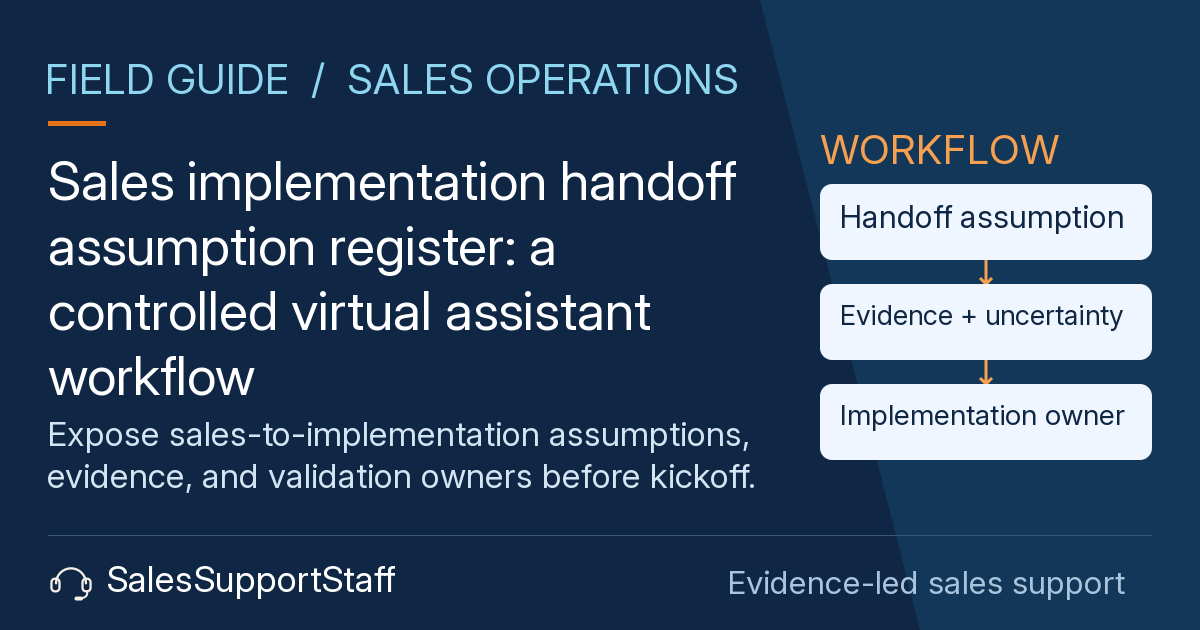
Implementation risk often hides in statements that sound settled: “standard integration,” “customer will migrate,” or “launch in six weeks.” An assumption register turns those statements into testable records without converting sales notes into delivery commitments.
Build an implementation handoff assumption register from deal evidence
Review scope documents, order forms, solution notes, emails stored in approved systems, and recorded approvals. Capture one assumption per row with exact source wording, source date, affected workstream, consequence if false, and proposed validation owner. Do not rewrite ambiguity into certainty.
Separate contractual obligations, confirmed facts, estimates, dependencies, exclusions, and assumptions. A signed term belongs in the obligation register even if delivery staff question feasibility. Legal interpretation stays with authorized counsel.
Prioritize validation before kickoff
Score assumptions using the team’s defined impact and uncertainty scales. Ask owners to validate high-impact items such as data volume, integration availability, resource commitments, localization, security review, and launch dependencies first. Record the validation method and evidence required.
When customer confirmation contradicts a sales note, preserve both and open a scope decision. Never edit the note until disagreement disappears. The commercial and delivery owners decide whether the consequence is a plan change, change request, or clarification.
Hand over an owned exception list
At kickoff, show validated assumptions, open assumptions, rejected assumptions, resulting changes, and owners. Link each item to the affected milestone or requirement. A green project summary must not hide unresolved high-impact assumptions.
The handoff should state the precise assumption, original source, validation evidence, consequence, decision deadline, and accountable delivery or commercial owner. The assistant maintains the register but does not promise feasibility, dates, or scope.
Turn assumptions into testable statements
Write each assumption as a statement that could be confirmed or rejected, then attach its source, affected deliverable, owner, decision date, and consequence if false. Separate customer-stated facts, seller interpretations, delivery estimates, dependencies, and unresolved questions. Labels such as standard setup or light integration are too vague to govern implementation.
Link every assumption to the sold scope or explicitly mark it as outside the executed documents. NASA's Systems Engineering Handbook is useful background for disciplined project and technical management, while the signed agreement and implementation governance remain authoritative. Support staff document the boundary; they do not expand scope.
Review high-impact uncertainty first
Prioritize assumptions that affect access, data migration, integrations, staffing, dates, security review, training, and acceptance. Show the evidence needed to resolve each one and the person authorized to answer. If an assumption has no owner, route that governance gap rather than assigning a convenient employee.
Walk a normal assumption, a contradicted promise, a missing customer dependency, and an out-of-scope request through the procedure. Preserve the original wording when it came from a meeting note or proposal. Once resolved, append the decision and effective date instead of deleting the earlier state.
Hand implementation a living register
The handoff should group open items by milestone and show status, exposure, next evidence, owner, and due date. Link confirmed decisions to the requirement, task, or change-control record they affect. Reopen an item when the underlying scope or dependency changes.
Measure assumptions open at kickoff, overdue decisions, items resolved before their affected milestone, and work changed after an assumption proved false. Do not turn the counts into delivery-impact claims without separate evidence. Broader delegation controls appear in the sales operations virtual assistant guide.
Commission the queue deliberately
Create a pilot sheet with assumption statement, source wording, affected deliverable, confidence, consequence, decision owner, due date, and resolution evidence. Require the implementation lead to approve field definitions, acceptable sources, and stop conditions before access is granted. Include one ordinary record, one incomplete record, one conflict, and one edge case where a contradicted note changes the delivery dependency.
For Sales implementation handoff assumption register, ask the candidate to process assumption statement, source wording, affected deliverable, confidence, consequence, decision owner, due date, and resolution evidence without customer contact or production edits. Review whether the output preserves received values, identifies controlling evidence, explains each stop, and routes decisions to the named owner. Reject work that looks tidy but cannot be rebuilt from attached sources.
Document role access for assumption statement, source wording, affected deliverable, confidence, consequence, decision owner, due date, and resolution evidence; remove export privileges unless Sales implementation handoff assumption register requires them, and test revocation before the pilot ends. Keep sample data synthetic or appropriately minimized. Record retention and deletion responsibilities beside the queue owner so cleanup becomes an operating step.
After launching Sales implementation handoff assumption register, inspect risk-based and random samples across assumption statement, source wording, affected deliverable, confidence, consequence, decision owner, due date, and resolution evidence. Compare false acceptance, false return, unresolved cases, reopened records, and correction time, with denominators and exclusions visible. When a governing source changes, retest the relevant fixture before applying the rule broadly.
Contact SalesSupportStaff to design the Sales implementation handoff assumption register intake sheet around assumption statement, source wording, affected deliverable, confidence, consequence, decision owner, due date, and resolution evidence, with a traceable owner review. The CRM data hygiene guide explains source maintenance, and the sales operations virtual assistant guide explains how to place the queue inside a managed support role.
A final calibration should use fresh examples of Sales implementation handoff assumption register, including a borderline record and a corrected record. Have the accountable owner explain any disagreement in writing, then add that ruling to the next procedure version without changing the evidence retained for the original case. For this calibration, compare assumption statement, source wording, affected deliverable, confidence, consequence, decision owner, due date, and resolution evidence.
Frequently asked questions
Is every sales note an assumption?
No. Classify obligations, facts, estimates, exclusions, dependencies, and assumptions separately.
What should be validated first?
High-impact assumptions with weak evidence or near-term milestone effects.
Can contradictory evidence be overwritten?
No. Preserve it and route the scope conflict for a named decision.
Who owns the register after kickoff?
The designated implementation owner, with commercial owners retaining deal decisions.
Related articles
Map a Fallback Owner for Every Lead Routing Rule
Build a lead routing map with a named fallback owner for every branch, a dwell limit, replayable routing events, and a weekly exception review.
Sales OperationsVerify the Source Behind Every Quote Line Item
A line-level quote review that ties every price, quantity, and term to a versioned source before the document reaches the buyer.
Sales OperationsBuild a No-Show Recovery Queue With Named Ownership
Define a no-show, start recovery the same day, cap attempts, and measure recovered meetings without double-booking the calendar.