
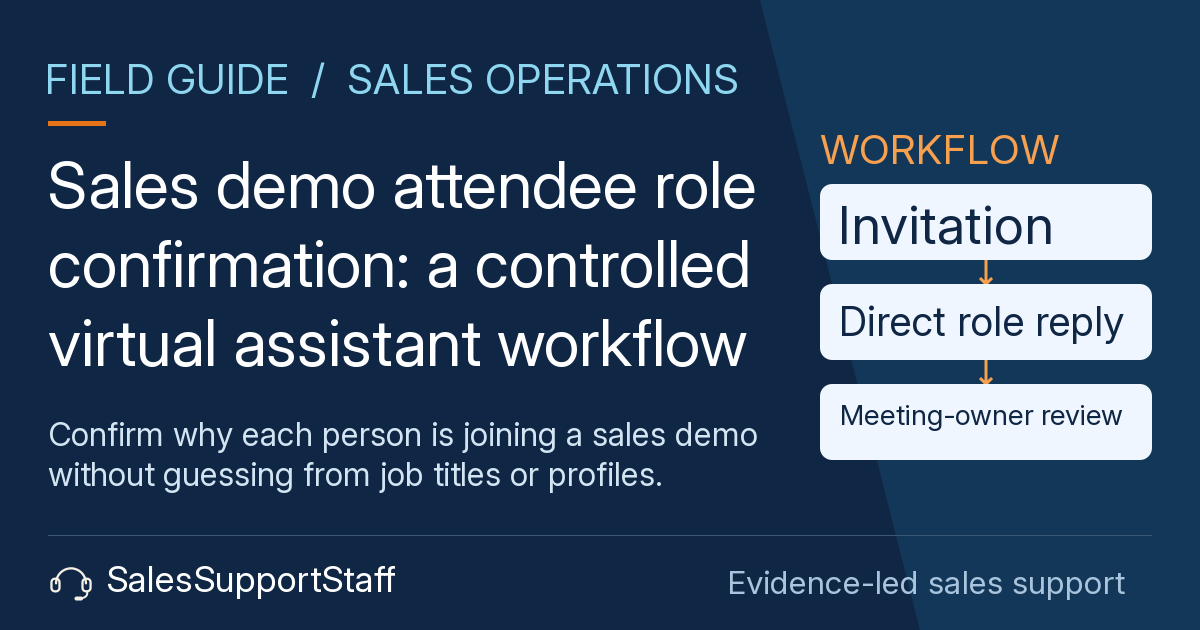
A useful demo roster answers a practical question: who needs to see which part of the product? An assistant can confirm the answer from invitations and direct replies, but a title alone is not evidence of buying authority, technical ownership, or budget control.
A reliable demo attendee role confirmation starts with the meeting
Capture the calendar event ID, account, scheduled time, organizer, attendee address, and the exact role wording supplied by the attendee or meeting owner. Distinguish “will attend” from “was invited,” and keep optional guests out of the confirmed count.
Send one neutral clarification when the role is absent: ask which part of the evaluation the person will represent. Do not offer a menu that pressures the recipient into a purchasing role. Record the reply verbatim and its timestamp.
Build a run of show from confirmed needs
Map confirmed interests to agenda segments such as security, administration, workflow, or commercial review. Put unconfirmed interests in a question list rather than silently expanding the demo. The account executive owns the final agenda and any claim about decision influence.
If a new attendee appears shortly before the call, flag the change with the evidence available. A same-domain email does not prove employment, and an external address may be a legitimate adviser. The meeting owner decides whether identity verification is needed.
Use attendance evidence carefully
After the meeting, reconcile the accepted calendar response, conferencing attendance log, and seller notes. Report conflicts such as a delegate joining under another display name instead of choosing whichever system looks complete. Attendance is evidence of presence, not agreement or authority.
The handoff should state the confirmed role wording, its source, unresolved identities, agenda changes, and the meeting owner who must decide any follow-up. Retain only the minimum contact data needed in approved systems.
Reconcile identity without inventing seniority
Start with the registration response, calendar acceptance, meeting roster, and any role wording supplied directly by the attendee or account owner. Keep employer, department, job title, meeting role, and buying responsibility as separate fields. A title found on a public profile may help form a question, but it should not silently overwrite first-party information.
Mark each role as confirmed, supplied but unconfirmed, inferred, conflicting, or unknown. The NIST Privacy Framework provides a durable reference for managing privacy risk when collecting identity information. Apply data minimization: the demo team usually needs meeting relevance and an accountable follow-up owner, not an assembled biography.
Prepare the facilitator's roster
Order the roster by the meeting's actual needs rather than presumed hierarchy. Show the attendee's supplied wording, evidence source, confirmation time, agenda relevance, requested accommodation, and unresolved question. Put late additions and forwarding recipients in a change log so the facilitator can see which assumptions appeared after preparation.
Do not label someone a decision maker, champion, blocker, or technical evaluator unless an approved source supports that description. If role evidence conflicts, quote the short conflicting labels and ask the account owner for a decision. Customer contact and enrichment beyond the authorized preparation task require separate approval.
Measure useful readiness
Before the meeting, test one confirmed attendee, one unknown attendee, one duplicate identity, and one last-minute substitution. A passing roster lets the facilitator distinguish fact from assumption and identify who owns each unresolved item. Afterward, record whether the ambiguity was resolved without converting meeting behavior into an unsupported permanent label.
Track rosters delivered on time, unresolved identities at handoff, corrections, privacy deletions, and role labels later rejected by the owner. Review a sample against original responses rather than scoring the number of fields populated. Broader record-maintenance guidance is available in the CRM data hygiene guide.
Commission the queue deliberately
Create a pilot sheet with registration wording, invitation address, employer, meeting role, agenda interest, confirmation time, conflict status, and follow-up owner. Require the account executive to approve field definitions, acceptable sources, and stop conditions before access is granted. Include one ordinary record, one incomplete record, one conflict, and one edge case where a forwarded invitation introduces an unconfirmed identity.
For Sales demo attendee role confirmation, ask the candidate to process registration wording, invitation address, employer, meeting role, agenda interest, confirmation time, conflict status, and follow-up owner without customer contact or production edits. Review whether the output preserves received values, identifies controlling evidence, explains each stop, and routes decisions to the named owner. Reject work that looks tidy but cannot be rebuilt from attached sources.
Document role access for registration wording, invitation address, employer, meeting role, agenda interest, confirmation time, conflict status, and follow-up owner; remove export privileges unless Sales demo attendee role confirmation requires them, and test revocation before the pilot ends. Keep sample data synthetic or appropriately minimized. Record retention and deletion responsibilities beside the queue owner so cleanup becomes an operating step.
After launching Sales demo attendee role confirmation, inspect risk-based and random samples across registration wording, invitation address, employer, meeting role, agenda interest, confirmation time, conflict status, and follow-up owner. Compare false acceptance, false return, unresolved cases, reopened records, and correction time, with denominators and exclusions visible. When a governing source changes, retest the relevant fixture before applying the rule broadly.
Contact SalesSupportStaff to design the Sales demo attendee role confirmation intake sheet around registration wording, invitation address, employer, meeting role, agenda interest, confirmation time, conflict status, and follow-up owner, with a traceable owner review. The CRM data hygiene guide explains source maintenance, and the sales operations virtual assistant guide explains how to place the queue inside a managed support role.
Frequently asked questions
Can a job title establish an attendee role?
No. Treat it as a clue and seek direct confirmation or a meeting-owner decision.
What if an assistant accepts for an executive?
Record the response source and ask whether the assistant or executive will attend; do not infer delegation authority.
Should no-shows be removed?
Preserve the invitation history and mark attendance separately so the record remains explainable.
Who approves the final agenda?
The accountable meeting owner, not the administrative assistant.
Related articles
Map a Fallback Owner for Every Lead Routing Rule
Build a lead routing map with a named fallback owner for every branch, a dwell limit, replayable routing events, and a weekly exception review.
Sales OperationsVerify the Source Behind Every Quote Line Item
A line-level quote review that ties every price, quantity, and term to a versioned source before the document reaches the buyer.
Sales OperationsBuild a No-Show Recovery Queue With Named Ownership
Define a no-show, start recovery the same day, cap attempts, and measure recovered meetings without double-booking the calendar.